
How Does IPTV Streaming Work?
IPTV streaming is revolutionary. You've probably wondered how your IPTV service manages to deliver thousands of channels…
On this page (6)
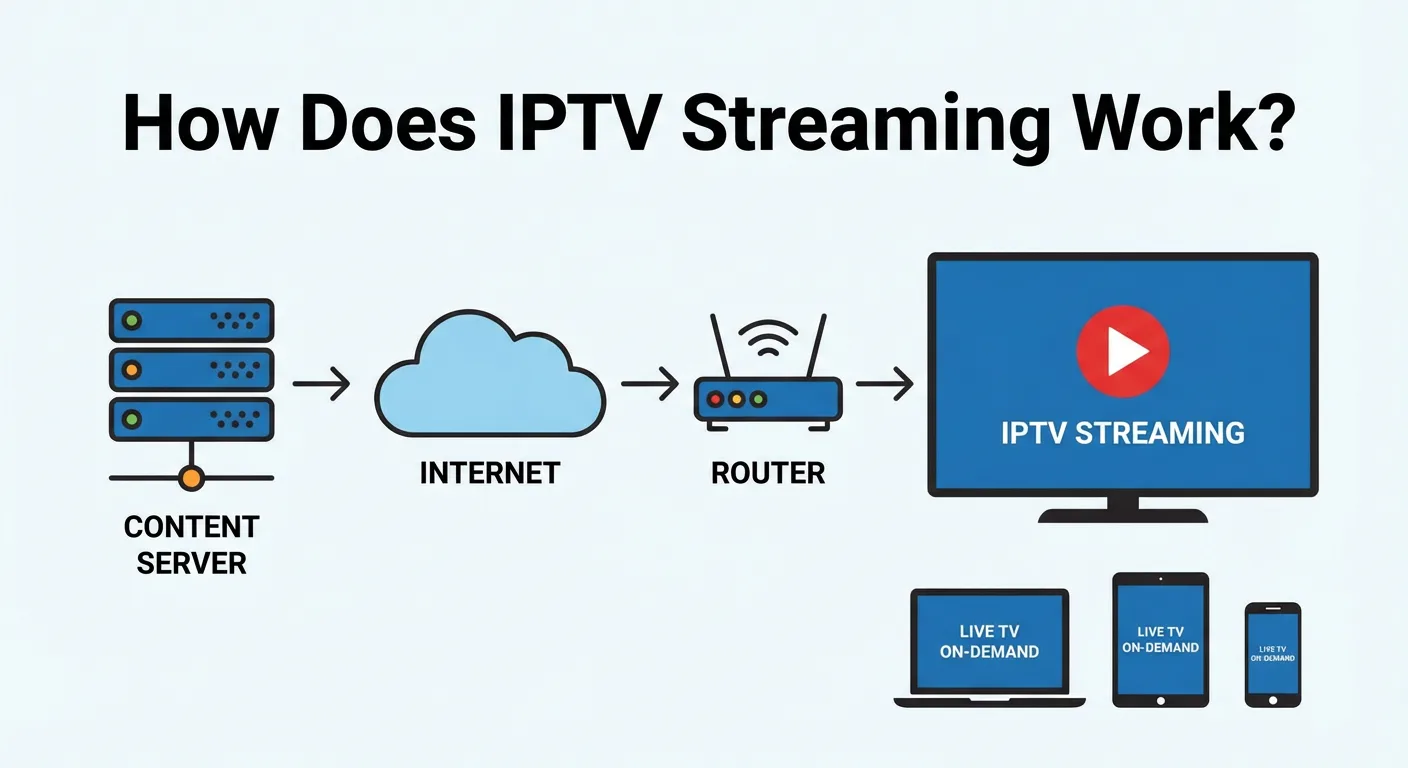
You’ve probably wondered how IPTV streaming manages to deliver thousands of channels through your internet connection instead of traditional cable infrastructure.
It’s not just about sending video packets—there’s an intricate dance between multicast protocols, CDN nodes, and middleware systems that orchestrate every stream.
Understanding the technical architecture behind IPTV reveals why some services excel while others buffer endlessly. The real complexity lies in how these systems handle millions of concurrent connections.
How does IPTV work?
When you’re IPTV streaming content, the underlying transmission architecture relies on multicast and unicast protocols operating over IP networks to deliver packetized video data from headend servers to client devices.
Your set-top box receives RTP/RTSP streams while IGMP manages multicast group memberships across routers. The middleware layer handles authentication, EPG data, and VOD requests through HTTP-based IPTV protocols.
Video compression standards like H.264/AVC and H.265/HEVC reduce bandwidth requirements by 50-75%, enabling efficient transmission. You’ll encounter adaptive bitrate streaming where encoders generate multiple quality variants.
The CDN infrastructure caches content at edge servers, minimizing latency. QoS mechanisms prioritize video packets using DSCP marking and traffic shaping. Your ISP’s network must support sustained throughput of 15-25 Mbps for 4K streams while maintaining packet loss below 0.01%.
What components does IPTV streaming need?
Understanding the transmission protocols provides the foundation for examining the physical and logical components that comprise a complete IPTV deployment. Critical infrastructure elements include:
- Headend facility: Houses encoders, transcoders, and content management systems that ingest broadcast feeds and VOD assets.
- Middleware servers: Handle authentication, EPG data, DRM enforcement, and coordinate with billing systems.
- Network infrastructure: Requires edge routers, DSLAM equipment, and multicast-enabled switches supporting IGMP snooping.
- Set-top boxes: Decode H.264/H.265 streams, process conditional access modules, and render the user interface.
- CDN nodes: Cache popular content closer to subscribers, reducing backbone traffic and improving performance.
- Content management platform: Orchestrates asset workflow, transcoding profiles, and metadata ingestion.
- Standardized APIs: Enable communication and interoperability across different vendors’ equipment.
Each component works synchronously to deliver seamless IPTV streaming service from content source to your device.
How does IPTV content reach your device?
After your IPTV channels and content provider receives raw broadcast signals or file-based media, the encoding pipeline initiates multi-stage processing that transforms these sources into IP-deliverable packets. The process includes:
- Transcoders compress video using H.264/AVC or H.265/HEVC codecs, reducing bandwidth requirements while maintaining quality.
- Streams are segmented into 2-10 second chunks for adaptive bitrate streaming via HLS or MPEG-DASH protocols.
- CDN edge servers cache popular segments near you, reducing latency.
- Middleware orchestrates content encoding workflows, managing DRM encryption and manifest generation.
- Your device’s player requests the m3u8 playlist, fetches segments sequentially, and buffers them for playback.
- Load balancers distribute your requests across origin servers, ensuring optimal throughput and failover redundancy.
Your requested content traverses these multiple delivery mechanisms seamlessly, with each component working together to deliver smooth IPTV streaming content to your device.
What are the different types of IPTV services?
| Critères | Détails |
| Live Television | Protocoles: IGMP snooping, RTP/UDP • Transmission: Multicast • Latence minimale, bande passante efficace, routage optimisé |
| Video on Demand (VOD) | Protocoles: RTSP, HLS/MPEG-DASH • Transmission: Unicast • Streaming adaptatif, livraison directe endpoint |
| Time-Shifted TV | Protocoles: Multicast + Unicast • Transmission: Hybride • Cache flux multicast, livraison unicast ultérieure |
| Middleware provider | Orchestre services via APIs standardisées, gère clés DRM, données EPG, authentification abonnés |
| Sélection protocole | Dépend de topologie réseau: FTTH, xDSL ou OTT |
| Paramètres QoS | Déterminés par type de connexion et stratégies de buffering |
| Traversée packets | Headend vers CPE via optimized routing tables |
How much bandwidth does IPTV need?
Four critical bandwidth thresholds define your IPTV deployment’s viability:
- SD streams require 2-4 Mbps sustained throughput.
- HD content demands 8-12 Mbps.
- 4K/UHD consumes 25-35 Mbps.
- Emerging 8K formats need 80-100 Mbps per concurrent stream.
You’ll need to provision your edge routers and CDN nodes accordingly, implementing QoS policies that prioritize RTP/RTSP traffic while maintaining sub-50ms jitter tolerances. Your network stability directly impacts packet loss ratios and buffering events. Essential configurations include:
- Configure IGMP snooping on managed switches to optimize multicast distribution.
- Deploy redundant paths using OSPF or BGP for failover scenarios.
- Implement forward error correction protocols.
- Monitor bandwidth requirements through SNMP polling, tracking metrics like interface utilization, packet drops, and retransmission rates.
- Deploy adaptive bitrate streaming algorithms that dynamically adjust to network conditions.
Proper network configuration and continuous monitoring ensure optimal IPTV streaming performance and service quality.
Frequently Asked Questions
Is IPTV Legal to Use in My Country?
You’ll need to verify your jurisdiction’s IPTV regulations and country-specific laws regarding content distribution protocols. Legal frameworks vary between territories, affecting multicast transmission rights, CDN infrastructure usage, and DRM-compliant streaming endpoints within your geographic region.
How Much Does IPTV Typically Cost per Month?
You’ll find IPTV protocol packages ranging from £10-50 monthly across various CDN infrastructures. Affordable options utilize basic multicast streaming, while premium pricing comparisons show advanced middleware systems with VOD servers, EPG integration, and redundant backbone configurations.
Can I Watch IPTV on Multiple Devices Simultaneously?
You’ll need to verify your provider’s simultaneous streaming limits and multi device compatibility through their CDN architecture. Most IPTV protocols support concurrent sessions, but bandwidth allocation and DRM restrictions determine actual device count per subscription.
What’s the Difference Between IPTV and Regular Cable TV?
You’ll find IPTV advantages include IP-based packet transmission over broadband infrastructure versus cable limitations using RF-modulated signals through coaxial networks. IPTV’s unicast/multicast protocols enable on-demand streaming, while cable’s broadcast topology restricts content delivery flexibility.
Do I Need a VPN to Use IPTV Services?
You don’t technically require a VPN for IPTV protocol transmission, but VPN advantages include encrypted packet routing through tunneled infrastructure. Streaming security improves via obfuscated IP endpoints, preventing ISP throttling and protecting multicast/unicast data streams.
Read more about IPTV encoding technology.
Your free trial login works in every app in this article. Twelve hours of the full service, no card, then choose a plan or stop.
- No credit card
- Login by email in minutes
- Setup guides for every device
